Isuzu engines are among the most common power units in excavators, construction machinery, agricultural equipment and generator sets. They are durable, but their heart today is electronics — the ECM controller that manages common rail injection, turbocharging, exhaust gas recirculation and communication with the operator panel. When the ECM fails, the machine stands still, and every day of downtime on a construction site or in the harvest season is costly.
Using a real Isuzu 4JJ1 engine (3.0 l, four cylinders, 52 kW, built in 2014) photographed in our workshop, this article shows how to read the labels, what the dashboard warning lights mean, which controller faults occur most often and what professional ECM regeneration looks like.
How to read the labels of an Isuzu 4JJ1 engine
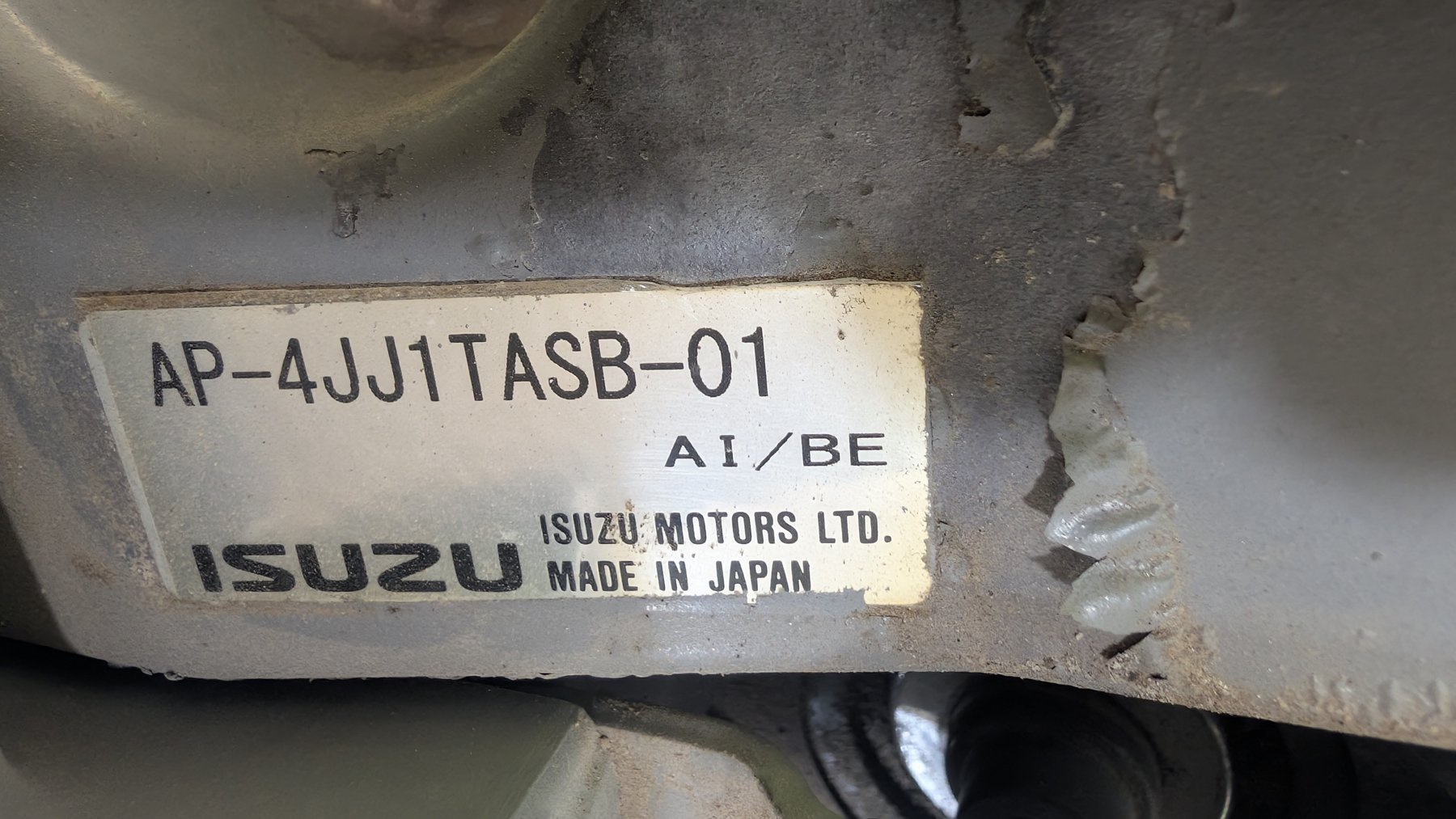
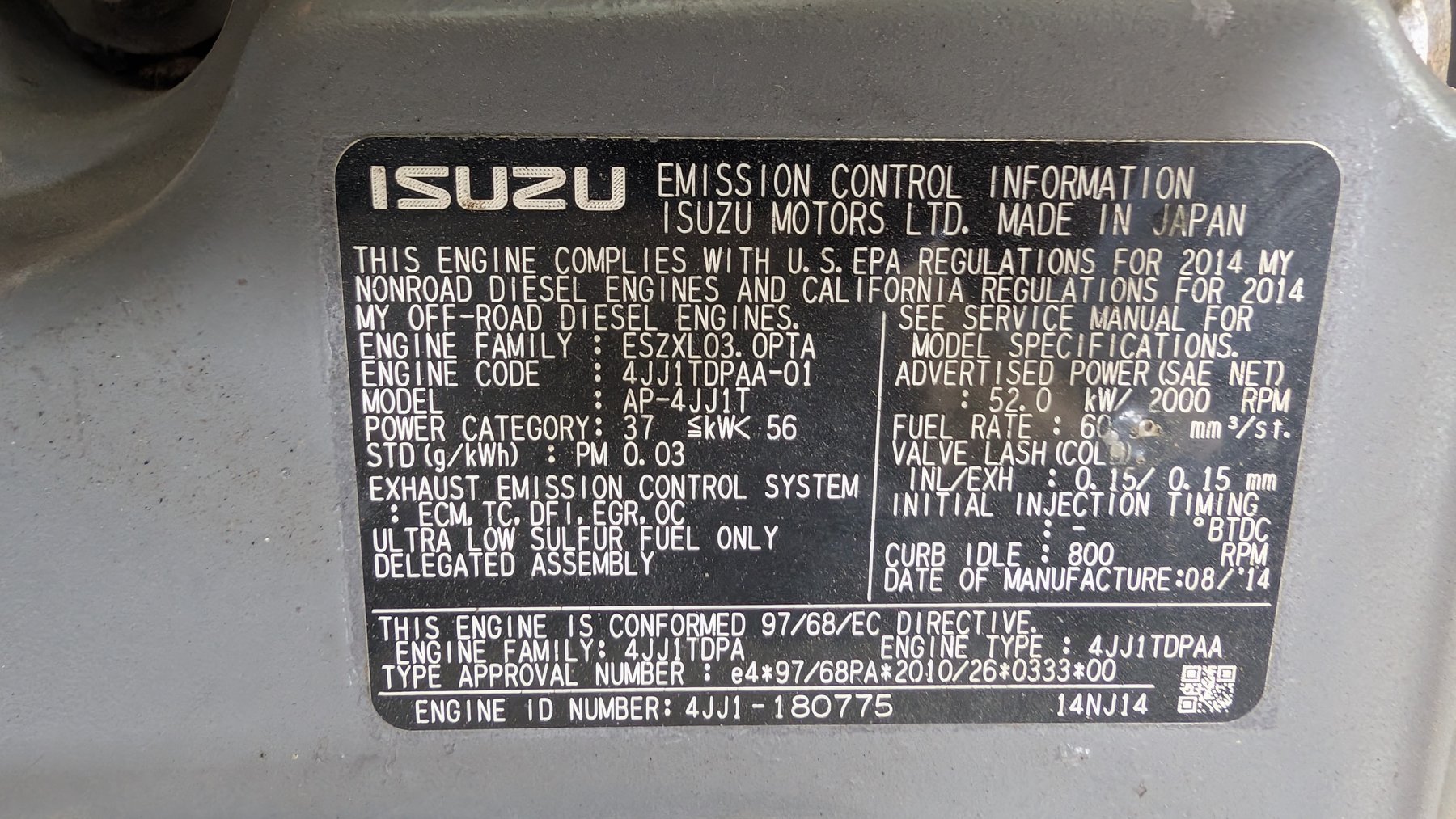
The first step of any diagnosis is to identify the engine precisely. The housing carries a plate marked AP-4JJ1TASB-01 and a black emission control information label that states the engine family, code, engine number, power and exhaust aftertreatment. From these data we know which ECM version and software the machine uses.
Note the abbreviation “ECM, TC, DFI, EGR, OC” — it stands for engine control module, turbocharger, direct fuel injection, exhaust gas recirculation and oxidation catalyst. All of these systems are supervised by a single controller, so its failure affects the whole engine.
| Parameter | Value from the label |
|---|---|
| Engine nameplate | AP-4JJ1TASB-01 (AI/BE), Isuzu Motors Ltd., Made in Japan |
| Engine family / code | 4JJ1TDPA / 4JJ1TDPAA-01 (ESZXL03.OPTA) |
| Model | AP-4JJ1T |
| Engine ID | 4JJ1-180775 |
| Power category | 37 ≤ kW < 56 |
| Advertised power (SAE net) | 52.0 kW at 2000 rpm |
| Curb idle | 800 rpm |
| Valve lash (cold) | 0.15 / 0.15 mm (intake / exhaust) |
| Date of manufacture | 08/2014 |
| Emission control system | ECM, TC, DFI, EGR, OC |
| Type approval | e4*97/68PA*2010/26*0333*00 (97/68/EC, EPA / CARB 2014 MY) |
| Fuel | ultra low sulfur fuel only |
Which machines use Isuzu engines and controllers
Isuzu 4JJ1, 4LE2, 4JG1, 4BG1, 4HK1 and 6HK1 engines are installed by many machine manufacturers. The table below shows typical applications; we always confirm the exact match by the engine number and ECM part number because the same engine code may exist in several electronic versions.
| Segment | Example machines / Isuzu engines |
|---|---|
| Crawler and wheeled excavators 12–20 t | Hitachi ZX110 / ZX120 / ZX130 / ZX135 / ZX140 / ZX160 / ZX180 / ZX210 |
| Mid-size and compact excavators of other brands | Case CX130 / CX135SR / CX160B, Kobelco SK140, Sumitomo SH120 / SH130 / SH150, Sany |
| Construction machinery: wheel loaders, dozers, rollers | Isuzu 4LE2, 4JG1, 4BG1, 6BG1, 4HK1, 6HK1, 6WG1 |
| Agricultural and forestry machines: tractors, sprayers, telehandlers, harvesters | 4JJ1, 4LE2, 4HK1 (zaleznie od modelu i rynku / depending on model and market) |
| Generator sets, pumps, compressors, compactors | Isuzu 4JJ1 / 4LE2 / 4JG1 |
What the ECM does in an Isuzu engine
The ECM (Engine Control Module) is the engine’s on-board computer. In the 4JJ1 common rail system it is responsible for:
- rail pressure control (high-pressure pump SCV valve, rail pressure sensor),
- injection timing and injector opening duration for every cylinder,
- turbocharger (TC) and EGR valve control,
- idle speed management (800 rpm) and speed regulation under load,
- handling coolant temperature, oil pressure, crankshaft and camshaft position sensors,
- CAN communication with the operator panel and other machine controllers,
- storing fault codes and the limp mode that reduces power.
The machine display: what the warning lights say
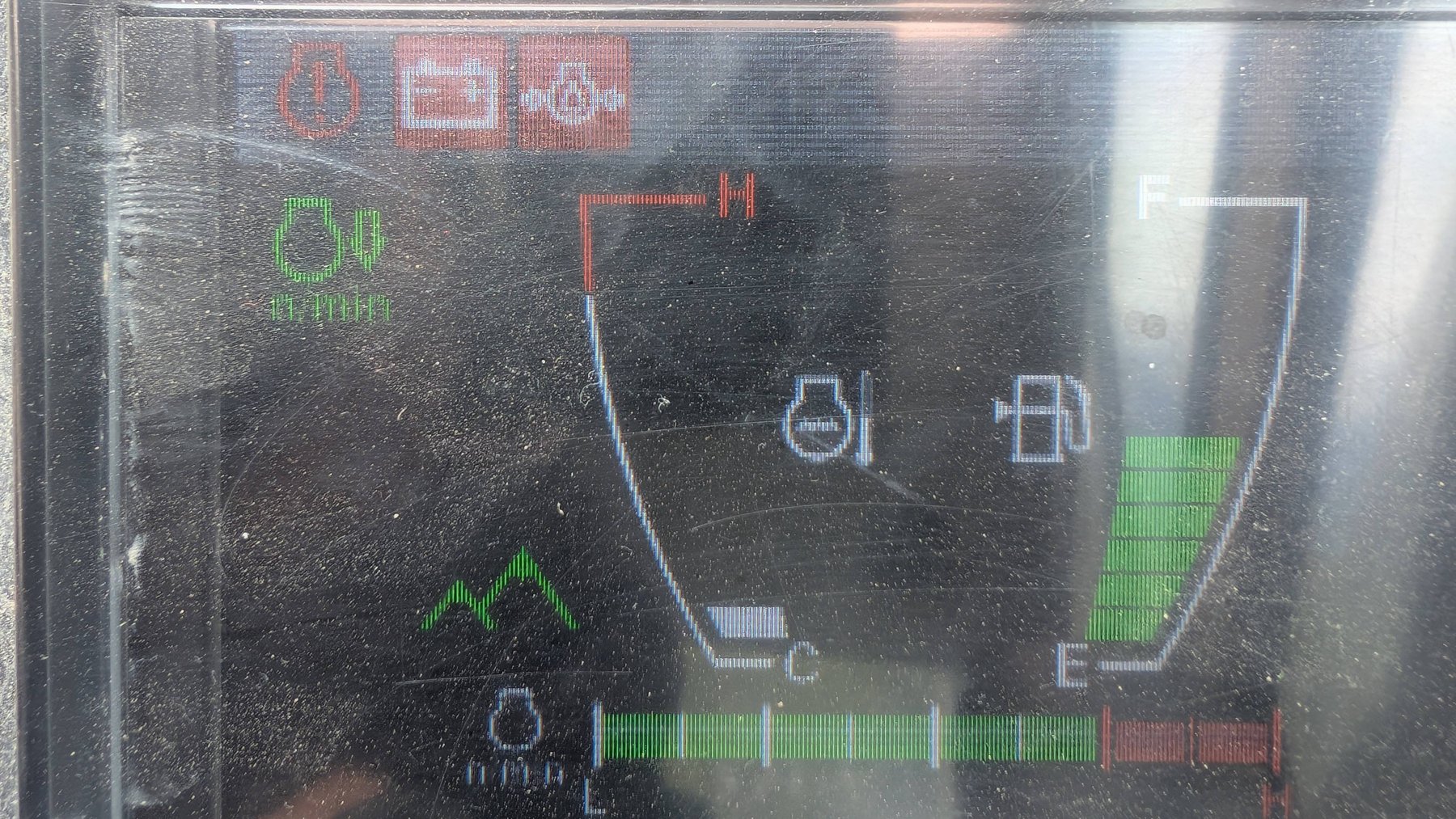
The cab photo shows several red warning lights (engine with exclamation mark, battery and an engine system icon), the coolant temperature gauge C–H, the fuel gauge E–F and the speed bar L–H. Operators often report this combination after charging loss or an ECM power supply failure. The table below helps narrow the search before we remove the controller.
| Signal on the display | What it may mean |
|---|---|
| Red engine warning with exclamation mark | a fault stored in the ECM (sensor, injection, rail pressure, EGR) — fault codes need to be read |
| Red battery warning | no charging: alternator, belt, grounds, fuse; low voltage can disturb the ECM |
| Red engine system warning (third icon) | an engine warning depending on the cluster model; we check the machine manual and diagnostic codes |
| Coolant temperature gauge C–H | overheating or a wrong sensor reading; compare with the actual temperature |
| Fuel gauge E–F and engine speed bar L–H | analog or CAN signal error between the ECM and the cluster |
Most common ECM failures in machines with Isuzu engines
Controllers in working machines operate in harsh conditions: vibration, moisture, dust, voltage spikes and large temperature swings. The most frequent faults are listed below.
| Symptom | Most common cause in the ECM / wiring | What we do |
|---|---|---|
| Engine cranks but does not start | failed injector driver stage or pump SCV driver, no ECM power supply, corrosion on the connector | Bench measurements, replacement of power transistors and regulators, simulator test |
| Engine stalls under load | cracked solder joints in the rail pressure sensor circuit, hairline PCB cracks | Ultrasonic cleaning, reflow soldering, protective coating |
| Engine light on, limp mode | wrong sensor signal or harness short, damaged analog inputs of the ECM | Fault code read-out, input test, repair or replacement of input circuits |
| No CAN communication with the panel | failed CAN transceiver, short on the bus | Transceiver replacement, bus test |
| Overheating, odd temperature readings | temperature sensor, harness or cooling system — rarely the ECM | Verify sensors and harness before touching the ECM |
| Battery warning, voltage drops | alternator, grounds, not always the ECM — but voltage spikes destroy ECMs | Voltage measurement, power and ground assessment, ECM repair if damaged |
Sensors, injectors and harness — not only the ECM
A proper diagnosis covers the entire common rail system: the rail pressure sensor, injectors, SCV valve, crankshaft position and temperature sensors, and the harness with connectors. Often the controller turns out to be healthy and the cause is a chafed wire or an oxidised contact. That is why we check everything before proposing a controller repair.
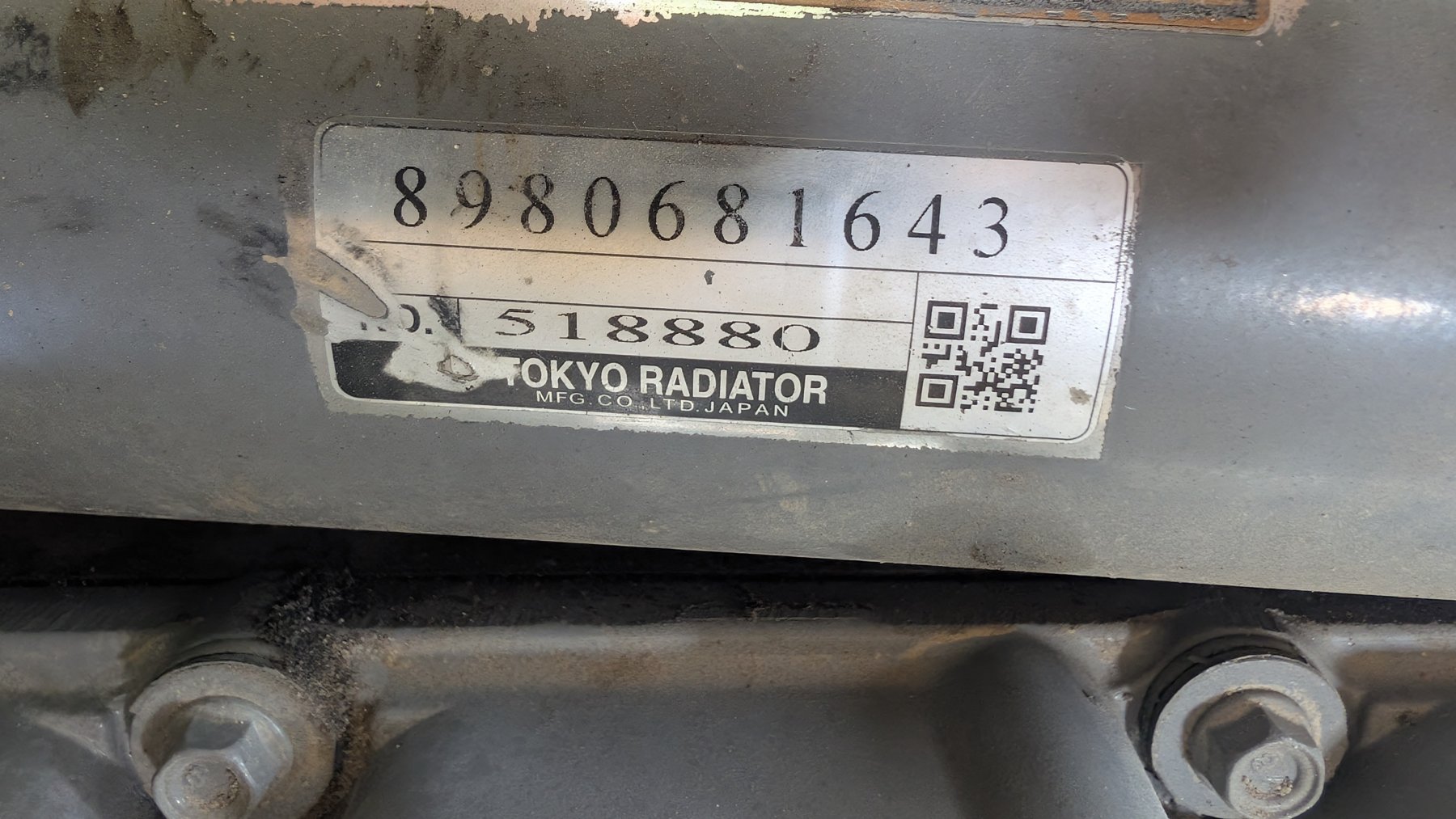
Cooling system and part labels: Tokyo Radiator
The photo shows the radiator label of Tokyo Radiator Mfg. Co., Ltd. (Japan) with the number 8980681643 — a numbering format consistent with Isuzu parts. Component labels make it easier to match parts and confirm the machine configuration.
Engine overheating is often wrongly blamed on the controller. Before suspecting the ECM we check radiator cleanliness, the thermostat, the water pump, the fan and the temperature sensor. Only when the signals are correct and the panel reading is still wrong do we examine the ECM analog inputs.
Agricultural machines with Isuzu engines
In the field season a controller failure is especially costly. Isuzu engines power tractors, self-propelled sprayers, telehandlers as well as generator sets and pumps on farms. Diagnostics are the same as for excavators, but we must account for dust, fertiliser moisture and long harnesses. For remote diagnosis, photos of the engine and ECM labels and a description of the symptoms are enough.

How ECM regeneration works in our workshop
- We receive your request: photos of the engine nameplate (e.g. AP-4JJ1TASB-01), the emission label, the display with warning lights and a description of the symptoms.
- We identify the ECM by part numbers and machine configuration and decide whether the fault is in the controller, the harness or the sensors.
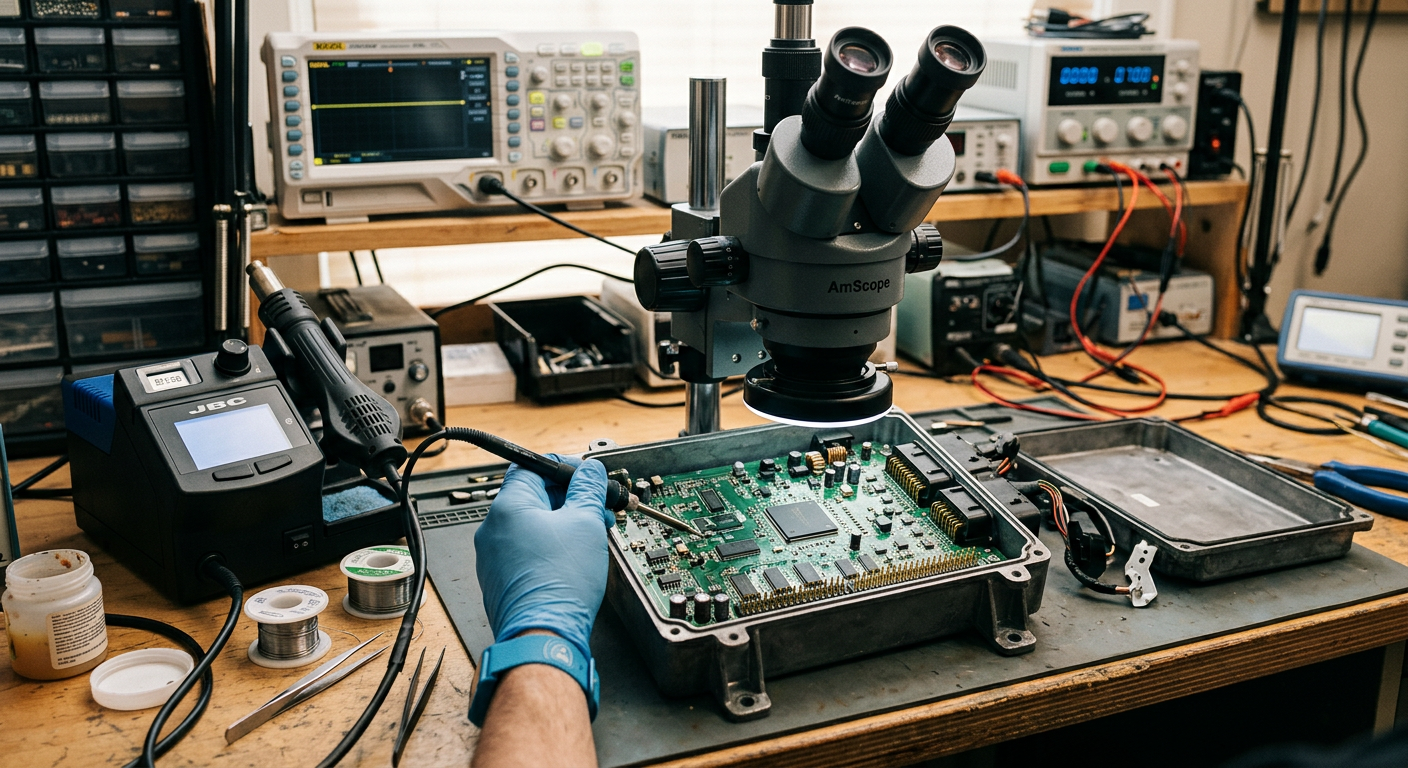
- After removal we inspect the board: corrosion, moisture traces, overheated parts, micro-cracked solder joints.
- We back up the memory data before any repair.
- We repair at component level: injector driver stages, power supplies, analog inputs, CAN transceivers, connectors.
- We test the ECM on a bench with a signal simulator (sensors, injector loads, CAN) and in a thermal cycle.
- We apply a protective coating and return the unit with a description of the work and recommendations for the installation.
How to prevent controller failures in machines
- Do not weld on the machine with the battery and ECM connected — disconnect the ground and the controller connectors.
- Avoid deep battery discharge and voltage spikes from jump-starting.
- Wash the engine bay regularly without aiming a pressure jet at the ECM connectors.
- Check the harness and connectors after working in mud, dust and moisture (construction, farming).
- Use only the fuel specified on the label (ULSD) and replace fuel filters regularly.
- Keep the radiator clean — overheating shortens the life of electronics and seals.
Key phrases in 6 languages
The table below lists the most searched phrases related to repairing controllers of machines with Isuzu engines in the languages supported by our website.
| PL | EN | DE | IT | CS | SK |
|---|---|---|---|---|---|
| naprawa sterownika silnika Isuzu | Isuzu engine ECM repair | Isuzu Motorsteuergerät Reparatur | riparazione centralina motore Isuzu | oprava řídicí jednotky motoru Isuzu | oprava riadiacej jednotky motora Isuzu |
| naprawa ECM koparki Isuzu 4JJ1 | excavator ECM repair Isuzu 4JJ1 | Bagger ECU Reparatur Isuzu 4JJ1 | riparazione ECU escavatore Isuzu 4JJ1 | oprava ECU bagru Isuzu 4JJ1 | oprava ECU bagra Isuzu 4JJ1 |
| sterownik silnika maszyny rolniczej | agricultural machine engine controller repair | Landmaschinen Motorsteuerung Reparatur | riparazione centralina macchine agricole | oprava řídicí jednotky zemědělských strojů | oprava riadiacej jednotky poľnohospodárskych strojov |
| regeneracja sterownika common rail | common rail ECU regeneration | Common-Rail Steuergerät instandsetzen | rigenerazione centralina common rail | regenerace řídicí jednotky common rail | regenerácia riadiacej jednotky common rail |
| kontrolka silnika koparka diagnostyka | excavator engine warning light diagnostics | Bagger Motorwarnleuchte Diagnose | diagnosi spia motore escavatore | diagnostika kontrolky motoru bagru | diagnostika kontrolky motora bagra |
| silnik nie odpala, brak ciśnienia w listwie | engine no start, low rail pressure | Motor springt nicht an, Raildruck zu niedrig | motore non parte, pressione rail bassa | motor nestartuje, nízký tlak v railu | motor nenaštartuje, nízky tlak v rail |
Service area: Knurów, Silesia and remote service across Europe
Our workshop is based in Knurów, Poland. We visit customers within roughly 30 km: Gliwice, Zabrze, Rybnik, Mikołów, Orzesze, Pyskowice, Wodzisław Śląski, Tychy, Żory, Ruda Śląska and Bytom. Customers from other regions of Poland and Europe get remote diagnostics based on photos and courier shipping of controllers. We work Monday to Friday, 8:00–16:00.
FAQ — Isuzu ECM repair
Do you repair Isuzu 4JJ1 ECMs from excavators and agricultural machines?
Yes. We repair ECMs of Isuzu engines (4JJ1, 4LE2, 4JG1, 4HK1, 6HK1 and related) installed in excavators, construction and agricultural machines and generator sets. Please send photos of the labels and a description of the symptoms first.
The engine light is on — is it definitely the ECM?
No. The light is often caused by a sensor, the harness or the power supply. We always verify these before removing the controller so that we do not repair a healthy ECM.
How do I know which ECM my machine has?
A photo of the engine nameplate (e.g. AP-4JJ1TASB-01) and the emission information label (code 4JJ1TDPAA-01, engine number) lets us determine the configuration; we also ask for the ECM part number.
Can I send the controller by courier?
Yes. We serve customers across Poland and Europe remotely; the controller is shipped by courier after a preliminary diagnosis based on photos.
How much does the repair cost?
Every fault is different — after diagnostics we prepare an individual, free quotation before the repair starts.
Do you offer 24/7 service?
No. We work on business days (Monday–Friday) from 8:00 to 16:00 and do not offer round-the-clock or weekend on-call service.
Send your controller for diagnostics
Send photos of the engine nameplate, the emission label, the display with warning lights and a short description of the symptoms. After analysis we will prepare a free individual quotation.